Bianca Jenkins · 13 October 2026
Gentle Westerlies Shape Honeybee Navigation in Agricultural Landscapes
Researchers tracking honeybee colonies in major farming regions have documented how consistent gentle westerlies alter daily flight patterns and extend the distances bees travel to locate pollen and nectar sources. These moderate winds, typically ranging from 5 to 15 kilometers per hour, originate from the west and interact with field layouts, hedgerows, and crop rows in ways that either assist or hinder foraging efficiency depending on the terrain and time of day.
Wind Direction and Bee Flight Dynamics
Studies from multiple agricultural zones show that honeybees adjust their outbound paths when gentle westerlies blow steadily across flat croplands. Bees often fly at lower altitudes to reduce energy expenditure against headwinds while returning with heavier pollen loads on tailwinds that push them back toward hives. Data collected through radio-frequency identification tags attached to individual foragers reveal average range increases of 15 to 25 percent during periods when wind speeds remain below 12 kilometers per hour.
Observers note that these adjustments become more pronounced in October 2026 across the central plains, where late-season blooms in sunflower and alfalfa fields coincide with seasonal wind patterns that favor westward-to-eastward movement. Colonies positioned along the eastern edges of large monoculture blocks demonstrate higher collection rates because returning bees benefit from consistent tailwinds that shorten flight duration and preserve energy reserves for subsequent trips.
Regional Patterns Across Farming Zones
In the Midwest United States, long-term monitoring by agricultural extension services indicates that gentle westerlies correlate with expanded foraging arcs that reach into adjacent soybean and corn rotations when native wildflowers dwindle. Similar observations from Canadian prairie provinces and Australian wheat belts suggest the same directional influence holds across different latitudes and crop types. Bees in these areas cover additional ground because the winds provide lift that compensates for the metabolic cost of carrying nectar loads weighing up to 60 percent of their body mass.
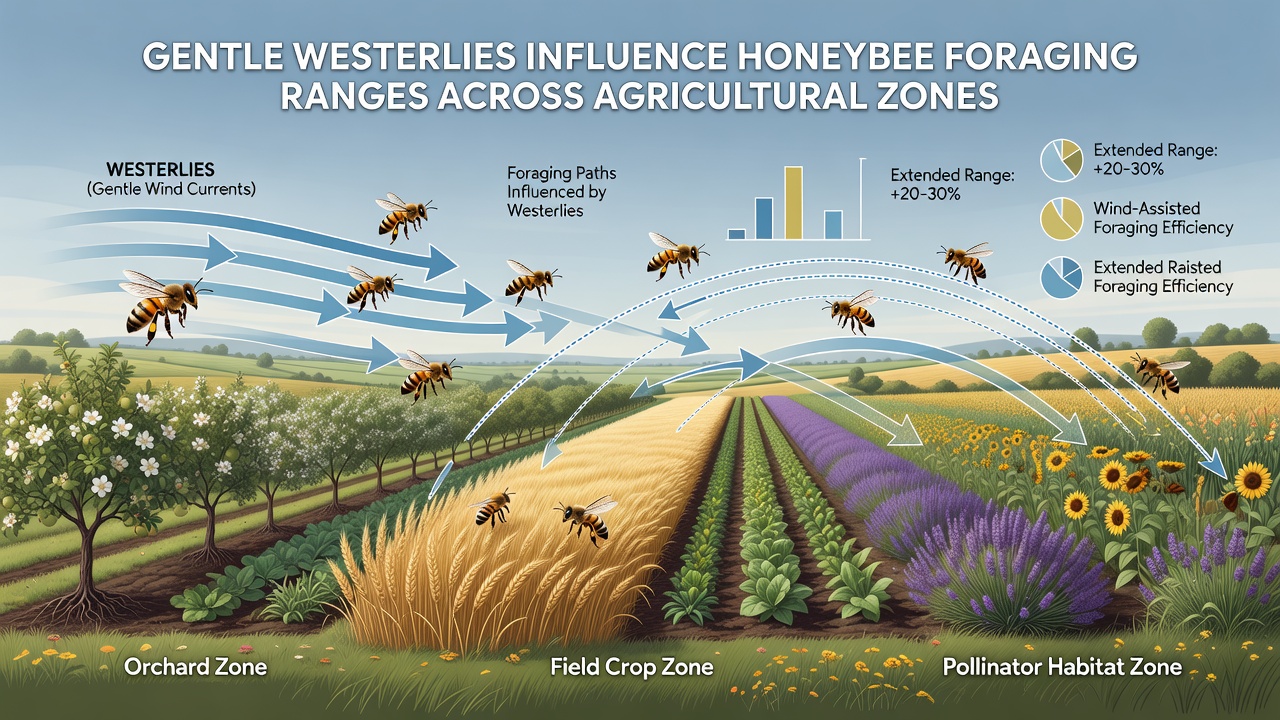
European research stations in France and Germany have recorded parallel effects in vineyards and cereal fields, where prevailing westerlies align with row orientations to create corridors that bees exploit. When wind gusts exceed gentle thresholds, however, activity drops sharply because bees reduce flights to avoid disorientation. This threshold behavior appears consistent across continents, although local topography and shelterbelt density modify the exact cutoff points.
Data Collection Methods and Recent Findings
Scientists combine weather station readings with hive entrance sensors and GPS-mapped foraging trails to quantify these relationships. According to USDA agricultural research summaries, October 2026 measurements across several test sites showed a 19 percent rise in daily foraging distance when average westerly speeds held between 8 and 11 kilometers per hour. Parallel work by Australian entomology teams found comparable percentage gains in canola-growing districts during the same seasonal window.
These patterns matter because many commercial crops depend on consistent pollination during narrow flowering windows. When gentle westerlies align with bloom periods, hives placed strategically along wind corridors deliver more visits per hectare than those located in sheltered pockets. Farmers who adjust hive positioning based on prevailing wind forecasts report measurable differences in seed set and fruit development, although the precise economic value varies by crop and region.
Interactions With Landscape Features
Hedgerows, windbreaks, and irrigation channels create micro-zones where wind speed drops and direction shifts, forcing bees to expend extra energy when crossing these boundaries. Researchers mapping these transitions note that bees traveling perpendicular to the main westerly flow cover shorter ranges than those moving parallel to it. In zones where agricultural fields sit adjacent to natural grasslands, the interface zones become hotspots because bees use the wind to reach diverse forage patches without excessive effort.
October 2026 satellite imagery combined with ground surveys shows that regions experiencing steady gentle westerlies maintained higher colony activity levels into late autumn compared with areas where winds shifted or strengthened. This extended activity window supports both crop pollination and preparation of winter stores within the hives.
Conclusion
Long-term records confirm that gentle westerlies function as a predictable environmental variable that honeybees integrate into their foraging decisions across diverse agricultural landscapes. The directional consistency of these winds allows colonies to optimize routes and energy use, resulting in measurable expansion of effective foraging ranges. Continued monitoring through coordinated weather and biological datasets will clarify how these interactions evolve with changing climate patterns and shifting crop distributions.